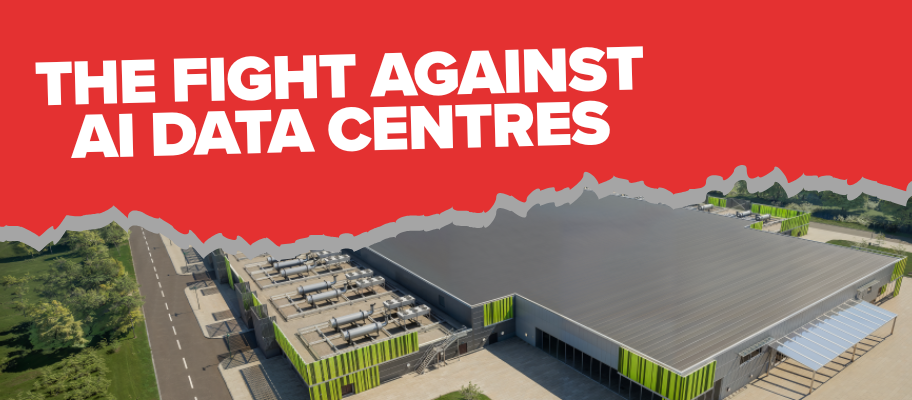
There are currently twenty-four proposals for AI data centres to be built in Scotland, a byproduct of the global AI boom.
This is a gravy train that both the Scottish and UK Government appear desperate to get on, despite the fact that the proposed “AI benefits” are negligible at best, and at worst, only serve to worsen the numerous crises that working class communities face today.
Since ChatGPT arrived on the scene a few years ago, capitalist governments of all stripes have heralded the coming AI “revolution” as a cure-all treatment for the numerous crises that our economy faces by improving economic productivity.
Whatever “conveniences” AI may provide to everyday life, the costs far outweigh the benefits. The data centres used to power these machines are increasing our carbon emissions at a rate unthinkable just a few years ago. This is extremely dangerous at a time of ecological collapse where climate change threatens to make large parts of the earth uninhabitable alongside destroying entire ecosystems.
Already, record breaking heatwaves are killing hundreds in the UK, and they are set to worsen (no thanks to our AI addiction). Not only that, but data centres are gigantic machines of extraction. As elements of capital they suck up natural resources (water, energy) and transform them into enormous profit. Meanwhile, local communities are left with higher energy costs, obnoxious noise pollution, and a blighted natural landscape.
So where does Scotland come into the picture? Various companies have applied to build hyper-scale data centres on sites across the country, mostly within the Central Belt. The Scottish Government has given its full-throated support whilst cynically wrapping it up in social justice language, referring to them as “green data centres”.
This title is grossly misleading, simply because it comes without definition. For example, a proposed Edinburgh data centre claims to be green despite the fact it will rely on backup power from diesel generators, akin to 106,000 cars. For all its talk on making Scotland a progressive alternative to a reactionary Westminster regime, the SNP’s actions tell a different story.
What is to be done then? It is clear that Scotland’s “just transition” is anything but. We need rapid investment in green jobs, whether it’s building wind turbines, or rebuilding our railway system which never recovered from the Beeching cuts of the 1960s. With the steady hand of the state, massive investment in the green sector has the potential to guarantee well-paid, unionised jobs, reduce our carbon emissions and help tackle the cost of living crisis by making bills, as well as public transport, cheaper.
Scotland is in a state of decline. Decades of austerity and deindustrialisation juxtaposed with increasing wealth inequality have only made the lives of ordinary people worse. Job losses are the norm after the closure of Grangemouth and as North Sea oil and gas sheds employees daily. The green “just transition” promised to Scottish workers has failed to materialise, as the invisible hand of the market is unable to provide for them in the same way a state-led green industrial strategy could and should have. In its absence, the government has promoted the AI sector as a viable alternative for the future.
This obsession with AI represents a lack of serious care from our political class. Communities where these large data centres are going to be built have had no say in whether they want them there or not. This has echoes of the 1980s, when the Thatcher government ripped up and hollowed out local communities through the closure of the mines and other industry. Workers had no say in the loss of their employment and were left to fend for themselves in the face of rapacious market forces. Despite this, people aren’t taking these changes lying down.
Backlash within local communities in the face of these data centres is growing. A proposed Borders data center has been met with a groundswell of opposition as a community campaign has been set up to stop its development. People are becoming increasingly politicised by an issue that directly affects them; this is most noticeable in an era where politics and politicians are more and more detached from working class people.
This presents a unique opportunity for the left to get directly involved. We should go to these communities and help them resist the corporate takeover of land, and extraction of resources that should rightfully be in the hands of the people. By organising in these spaces we can amplify their demands and explain how the growth of data centres is not just some abstract issue but is part of capitalism’s inability to resolve the contradictions it creates.
The left is often accused of neglecting the interests of rural communities and not being visible in those areas but, in the absence of a mass socialist party in Scotland, this provides a springboard for us to make inroads in forgotten communities across the country and show that there is a political vehicle that can provide tangible solutions to everyday problems.
The AI boom is symptomatic of a wider political and economic system that is collapsing and threatens to take the planet and working class people down with it just so some billionaires can make an extra buck. But socialists shouldn’t let a good crisis go to waste.
It’s up to us to provide a genuine alternative: a program of green, well-paid jobs, democratic ownership of public utilities, properly funded public services, regeneration of our rural communities, and so on. There’s no reason the future has to be ruled by a mass surveillance tech oligarchy when we have the answers.